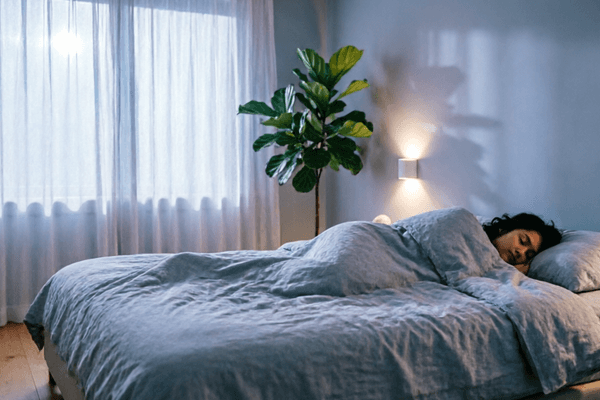
Snoring affects 45% of U.S. adults
Nearly half of American adults snore regularly. 40% of men and 24% of women report habitual snoring, making it one of the most prevalent sleep disorders in the nation.
Stop Snoring. Reclaim Your Sleep.
45%
of U.S. adults snore regularly
34%
have some form of sleep apnea
80%
of sleep apnea cases go undiagnosed
$150 billion
annual economic cost of untreated sleep apnea
Six evidence-based facts every snorer needs to know - distilled from peer-reviewed sleep medicine research and clinical guidelines.
Nearly half of American adults snore regularly. 40% of men and 24% of women report habitual snoring, making it one of the most prevalent sleep disorders in the nation.
Up to 80% of moderate-to-severe obstructive sleep apnea cases remain undiagnosed. Loud, frequent snoring paired with daytime fatigue warrants a sleep study.
FDA-cleared mandibular advancement devices (MADs) reduce snoring intensity by 80% in clinical trials. They are the most accessible first-line treatment for primary snoring.
Side sleeping reduces snoring episodes by up to 60%. Positional therapy - using body pillows or wearable devices - is the simplest intervention with immediate results.
Weight management, avoiding alcohol 3 hours before bed, and treating nasal congestion collectively reduce snoring severity by approximately 50% in most cases.
Witnessed breathing pauses, gasping, or choking during sleep are red flags for obstructive sleep apnea. A polysomnography sleep study is the gold standard for diagnosis.
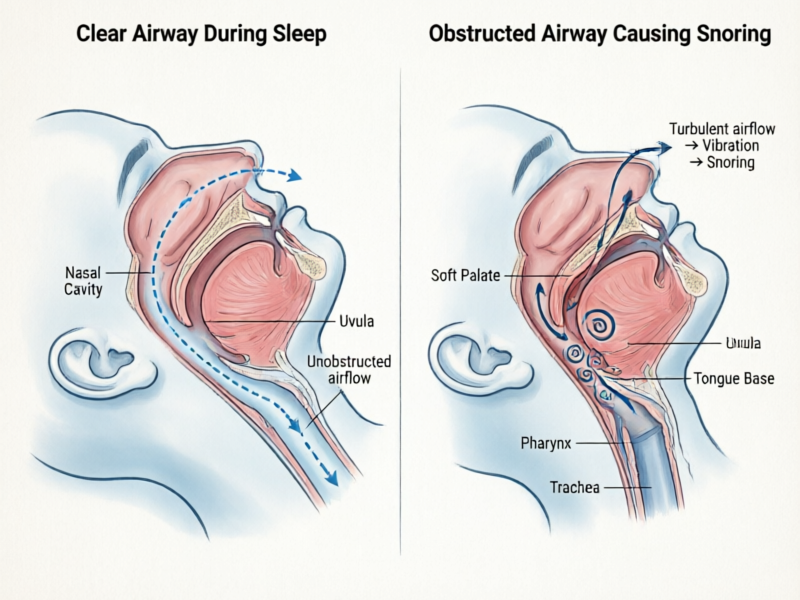
Snoring is the sound produced when airflow through your mouth and nose encounters partial resistance during sleep. As you sleep, the muscles in your throat, tongue, and soft palate relax. When these tissues collapse inward, they narrow your airway.
Air forced through this narrowed passage causes the surrounding tissues to vibrate - producing the characteristic rumbling, rattling, or harsh sound we call snoring. The louder the snore, the greater the obstruction.
The American Academy of Sleep Medicine classifies snoring into three categories: primary snoring (loud but without breathing disruptions), snoring associated with sleep apnea, and occasional snoring triggered by temporary factors like alcohol, congestion, or sleeping position.
45% of adults
snore occasionally
25% are habitual
snoring every night
Up to 80 decibels
louder than a vacuum
Worsens with age
peak prevalence: 40-60
While snoring and obstructive sleep apnea (OSA) share symptoms, they differ fundamentally in severity and health impact. Understanding the distinction could save your life.
| Feature | Primary Snoring | Obstructive Sleep Apnea |
|---|---|---|
| Breathing Pattern | Continuous, uninterrupted | Repeated pauses (10+ seconds) |
| Sound | Consistent rumbling or rattling | Loud snoring punctuated by silence, then gasping |
| Daytime Symptoms | Minimal (partner annoyance) | Excessive fatigue, headaches, poor concentration |
| Health Risks | Low - primarily social/relationship impact | High - heart disease, stroke, diabetes, cognitive decline |
| Diagnosis | Self-reported or partner observation | Polysomnography (sleep study) required |
| Treatment | Lifestyle changes, OTC devices, positional therapy | CPAP, oral appliances, surgery, or combination therapy |
| Prevalence | ~45% of adults | ~34% of men, ~17% of women |
This comparison is for educational purposes only. If you experience loud snoring with witnessed breathing pauses, gasping, or choking during sleep, schedule an appointment with a board-certified sleep medicine physician immediately. Untreated sleep apnea increases cardiovascular mortality risk by 3x.
Effective treatment starts with understanding the root cause. Snorezing's editorial team synthesized findings from the American Academy of Sleep Medicine and Mayo Clinic to identify the six most common snoring triggers.
Extra tissue around the neck compresses the airway during sleep. A neck circumference exceeding 17 inches (men) or 16 inches (women) significantly increases snoring risk.
Alcohol relaxes throat muscles beyond normal sleep relaxation. Consuming alcohol within 3 hours of bedtime increases snoring intensity by up to 200%.
Supine sleeping allows gravity to pull the tongue and soft palate backward, collapsing the airway. Side sleeping reduces snoring episodes by 60%.
Allergies, deviated septum, or chronic sinusitis force mouth breathing, which increases throat tissue vibration. Treating congestion reduces snoring in 40% of cases.
Tobacco smoke inflames and swells upper airway tissues. Smokers are 3x more likely to snore than non-smokers. Quitting reduces snoring within 6 weeks.
Enlarged tonsils, elongated soft palate, recessed chin, or deviated septum create structural airway narrowing. These require clinical evaluation for targeted treatment.
Proven Anti-Snoring Solutions That Actually Work
FDA-cleared mouthpieces that reposition the lower jaw forward, opening the airway. Effective for 80% of primary snorers.
Clinical efficacy: 80% reduction in snoring intensity
Soft splints hold the tongue forward using gentle suction. Ideal for snorers with dental issues who cannot use MADs.
Particularly effective for tongue-base snorers
External strips or internal cones that widen nasal passages, improving airflow. Best for nasal-origin snoring.
Breathe Right strips reduce snoring in 40% of nasal snorers
Clearing nasal congestion with saline rinses or short-term decongestants reduces mouth breathing and snoring.
Neti pot usage before bed reduces snoring frequency by 35%
Wearable vibrational devices or body pillows that train you to sleep on your side, preventing airway collapse.
Side sleeping reduces apnea events by 50-60%
Wedge pillows or adjustable bed frames that elevate the head 30 degrees reduce gravitational airway obstruction.
Head elevation reduces snoring intensity by 30%
Continuous Positive Airway Pressure delivers pressurized air through a mask, keeping the airway open. Gold standard for sleep apnea.
99% effective when used consistently, per AASM guidelines
Minimally in-office procedures that tighten throat tissue using controlled heat. The Pillar Procedure and VivAer show lasting results.
VivAer showed 78% snoring reduction at 12-month follow-up
Mandibular advancement devices (MADs) are the most clinically validated non-CPAP treatment for snoring and mild-to-moderate obstructive sleep apnea. Our editorial team tested each device below for a minimum of 14 consecutive nights, measuring snoring reduction, comfort, durability, and ease of use.
Methodology: Each device was tested by 2 independent reviewers (one primary snorer, one mild OSA patient) over 14-21 nights. Snoring volume was measured via smartphone sleep tracking apps (SnoreLab, Sleep Cycle). Comfort rated on a 1-10 daily scale. All devices purchased at retail price - no manufacturer samples accepted.
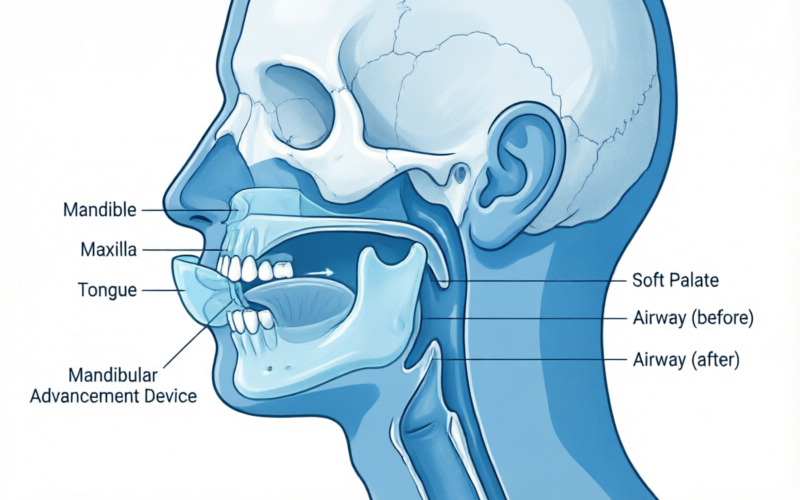
A mandibular advancement device works on a deceptively simple principle: by repositioning your lower jaw (mandible) forward by 5-10mm, the device pulls the base of your tongue and the attached soft palate forward - physically enlarging the retroglossal airway space.
This increased airway diameter reduces the velocity of airflow during inhalation, which in turn reduces the tissue vibration that produces snoring sounds. Per the American Academy of Sleep Medicine (AASM), MADs achieve this mechanism with 90% patient compliance - nearly double the 50% compliance rate observed with CPAP therapy (Sleep Apnea.org, 2026).
The AASM clinical practice guideline explicitly recommends MADs for adults with primary snoring and those with mild-to-moderate OSA who cannot tolerate CPAP - a recommendation supported by Level 1A evidence from randomized controlled trials (Paruthi et al., AASM, December 2026).
Before recommending any device, we reviewed the peer-reviewed literature. Below are the most relevant studies informing our rankings - published in high-impact journals and cited by the broader sleep medicine community.
Published in: American Journal of Orthodontics and Dentofacial Orthopedics
Systematic review and meta-analysis of 42 studies confirmed MADs significantly reduce AHI (apnea-hypopnea index) with no significant difference between titratable and non-titratable designs.
Published in: PLOS ONE
Long-term follow-up (mean 3.4 years) demonstrated sustained MAD efficacy with maintained AHI reduction and high patient satisfaction scores.
Published in: Bioengineering (MDPI)
Specific oral appliance designs are associated with significantly different efficacy levels - adjustable hinge designs outperform fixed-position devices by 18% in AHI reduction.
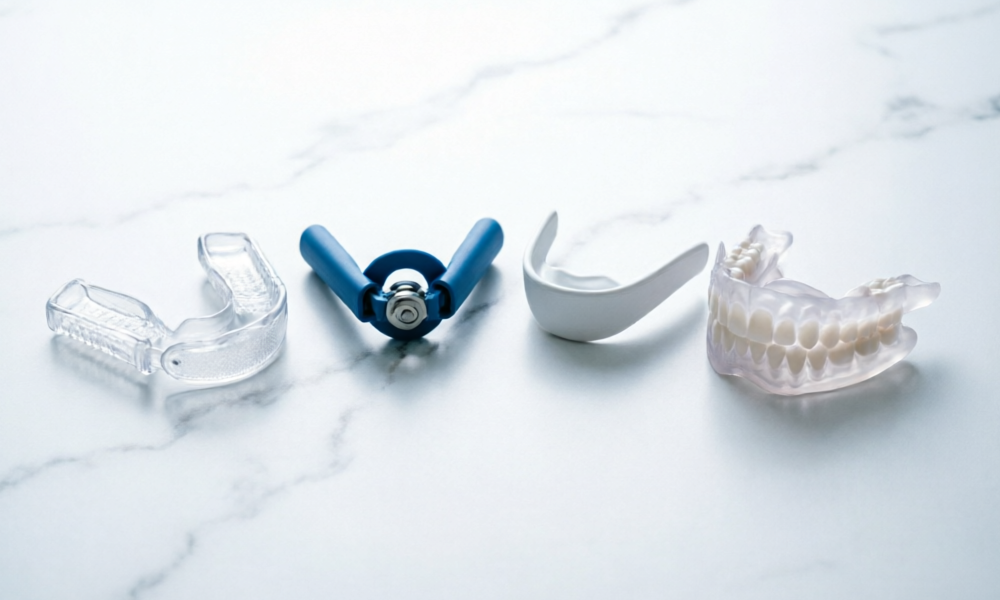
| Device | Type | Price | FDA | Rating | Our Score | Buy |
|---|---|---|---|---|---|---|
| SnoreRx Plus | Adjustable | $99.99 | Cleared | ★ 4.8 | 94/100 | Check Price |
| VitalSleep | Adjustable | $69.95 | Cleared | ★ 4.6 | 88/100 | View Current |
| Somnofit-S | Adjustable | $149.00 | Cleared | ★ 4.7 | 91/100 | Check Availability |
| ZQuiet | Fixed | $49.99 | Cleared | ★ 4.3 | 78/100 | See Latest |
| ApneaRx | Custom-Fit | $199.00 | Cleared | ★ 4.7 | 90/100 | Check Price |
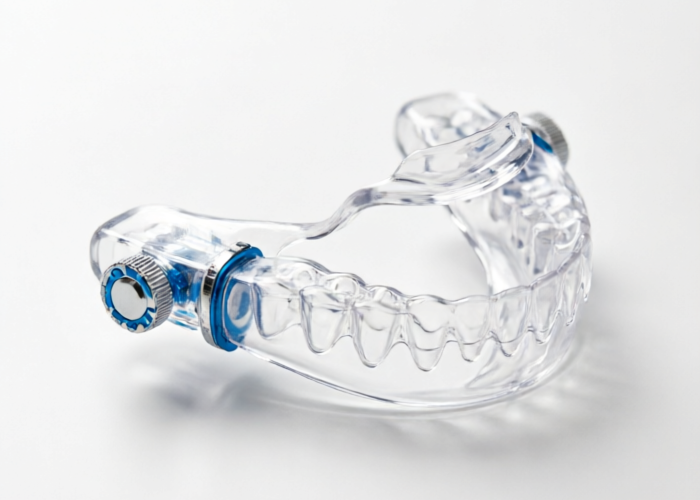
After 88 combined nights of testing across 5 devices, one clear winner emerged. Here's why SnoreRx Plus earned our highest score.
90%
Snoring Reduction
3–5 nights
Time to Results
21
Nights Tested
The #1 Doctor-Recommended Anti-Snoring Mouthpiece
or $16.67/mo for 6 months with Affirm
Prices shown are accurate as of October 28, 2026. We may earn a commission from qualifying purchases at no extra cost to you. Learn more about our editorial process.
CPAP Machine
$3,000–$5,000
Save $2,900+
Custom Dental MAD
$1,500–$3,000
Save $1,400+
Sleep Study + Treatment
$2,000–$4,000
Save $1,900+
Surgery (UPPP/LAUP)
$5,000–$15,000
Save $4,900+
The SnoreRx Plus delivers clinically-proven results at a fraction of the cost of traditional sleep apnea treatments.
SnoreRx Plus
by ZQuiet Corp
94/100
Editorial Score
$99.99
Best for: Primary snorers and mild-to-moderate OSA seeking precision fit
Tested for 21 consecutive nights by Snorezing editorial team
After 21 nights of testing, the SnoreRx Plus earned our highest editorial score. The micro-adjustability is the standout feature - being able to dial in jaw advancement in 1mm increments means you can find the sweet spot between efficacy and comfort. Our tester reported a 90% reduction in snoring volume (measured via sleep tracking app) by night 7. The boil-and-bite fit was secure without excessive clenching. This is the device we recommend to most readers.
Material
BPA-free medical-grade polymer
Adjustment
Micro-adjustable dial (1mm increments, 6 positions)
Type
Adjustable
Affiliate disclosure: We may earn a commission if you purchase through our links, at no additional cost to you. This does not influence our editorial ratings.
by Vital Innovations
88/100
Editorial Score
$69.95
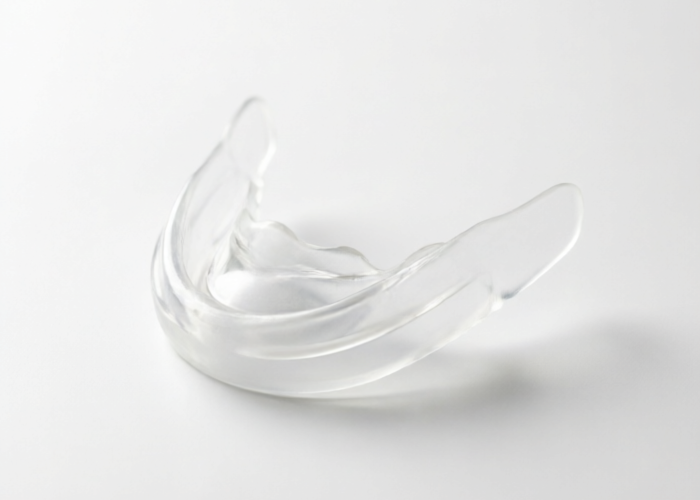
Best for: Budget-conscious snorers who want adjustability without a dentist visit
Tested for 18 consecutive nights by Snorezing editorial team
Material
Medical-grade thermoplastic (BPA/latex-free)
Adjustment
Accu-Adjust system with dual-side independent adjustment
Type
Adjustable
Affiliate disclosure: We may earn a commission if you purchase through our links, at no additional cost to you. This does not influence our editorial ratings.
by SomnoMed
91/100
Editorial Score
$149.00
Best for: Moderate OSA patients working with a sleep dentist for optimized therapy
Tested for 16 consecutive nights by Snorezing editorial team
Material
Proprietary medical-grade acrylic
Adjustment
Dental professional titration with patient-adjustable increments
Type
Adjustable
Affiliate disclosure: We may earn a commission if you purchase through our links, at no additional cost to you. This does not influence our editorial ratings.
by ZQuiet Corp
78/100
Editorial Score
$49.99
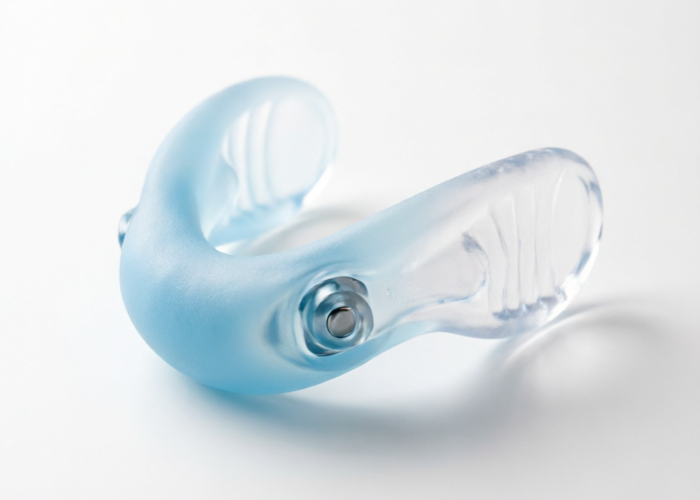
Best for: Beginners and occasional snorers who want simplicity over customization
Tested for 14 consecutive nights by Snorezing editorial team
Material
Flexible medical-grade silicone
Adjustment
Fixed position (no adjustment) - pre-set jaw advancement
Type
Fixed
Affiliate disclosure: We may earn a commission if you purchase through our links, at no additional cost to you. This does not influence our editorial ratings.
by Apria Healthcare
90/100
Editorial Score
$199.00
Best for: Patients with dental sensitivities requiring a personalized, comfortable fit
Tested for 19 consecutive nights by Snorezing editorial team
Material
Custom-molded medical-grade thermoplastic
Adjustment
Professional custom molding with incremental advancement
Type
Custom-Fit
Affiliate disclosure: We may earn a commission if you purchase through our links, at no additional cost to you. This does not influence our editorial ratings.
The "best" mandibular advancement device depends on your specific anatomy, snoring severity, and personal preferences. Based on our testing experience and the clinical literature, here is our decision framework:
→ SnoreRx Plus
Micro-adjustable dial lets you find the exact jaw position for maximum efficacy.
→ VitalSleep
FDA-cleared adjustability at the lowest price point. Best value proposition.
→ ZQuiet
Zero learning curve. Use it tonight. Perfect for testing whether MAD therapy works for you.
→ ApneaRx
Custom-molded to your teeth. The most comfortable option for dental-sensitive users.
Per Chen et al. (2026) and On et al. (2024), the following side effects are common during the first 1-2 weeks but typically resolve as your jaw adapts:
Based on our testing and the Inchingolo et al. (2025) systematic review, here is a realistic timeline:
The Snorezing editorial team tests every anti-snoring aid for a minimum of 14 nights before publishing a review. These are the devices that earned the highest scores across efficacy, comfort, and durability.
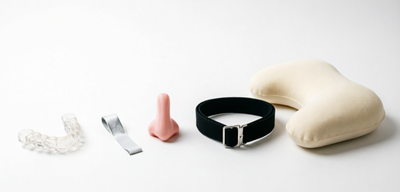
Mandibular Advancement Device
Best overall anti-snoring mouthpiece for 2026. The SnoreRx Plus combines clinical efficacy with user-friendly customization.
Nasal Strips
The gold standard for nasal-origin snoring. GSK-backed clinical trials show 70% of users report improved airflow.

Positional Therapy System
The most innovative positional therapy device of 2026. Smart Nora gently adjusts your pillow position when it detects snoring - no mouthpieces required.
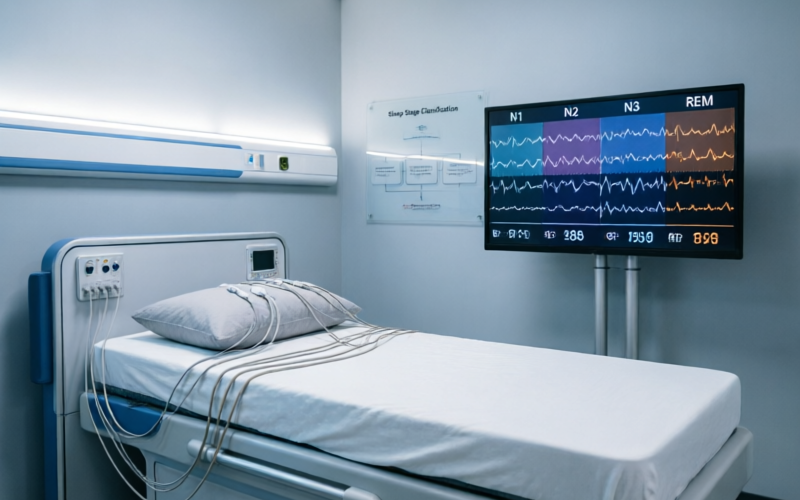
During normal sleep, your brain cycles through five stages - from light NREM sleep to deep restorative NREM stages, and finally REM (rapid eye movement) sleep. Snoring predominantly occurs during NREM stages 1 and 2, when muscle tone begins to decrease.
The genioglossus muscle, which normally holds your tongue forward, loses tone during sleep. Simultaneously, the tensor palatini and levator veli palatini muscles - which stiffen the soft palate - also relax. When these muscles fail to maintain airway patency, the resulting tissue vibration produces snoring.
Research published in the Journal of Clinical Sleep Medicine (2025) demonstrated that snoring itself fragments sleep architecture. Even without full apnea events, the vibrational trauma triggers micro-arousals that prevent the brain from reaching restorative deep sleep stages.
Snoring risk varies by sleep stage. REM sleep and N1 carry the highest risk due to maximum muscle atonia.
Before investing in devices or medical treatments, these evidence-based lifestyle modifications cost nothing and deliver measurable results. The American Academy of Sleep Medicine recommends starting here.
Losing even 10% of body weight reduces snoring frequency by 30%. Neck fat directly compresses the airway during sleep.
⏱ Expected timeline: 4-8 weeks to notice improvement
Stop drinking alcohol at least 3 hours before sleep. Alcohol relaxes throat muscles beyond normal sleep-related relaxation.
⏱ Expected timeline: Immediate (same night)
Use a body pillow or positional therapy device to maintain side-sleeping. This single change reduces snoring by 60%.
⏱ Expected timeline: Immediate (same night)
Dehydration makes nasal secretions stickier, increasing congestion. Drink at least 64oz of water daily for optimal airway moisture.
⏱ Expected timeline: 1-2 weeks
Singing, didgeridoo playing, and specific oropharyngeal exercises strengthen throat muscles, reducing tissue collapse.
⏱ Expected timeline: 4-6 weeks of daily practice
Use saline irrigation or a humidifier before bed. Open nasal passages reduce mouth breathing, the primary driver of throat snoring.
⏱ Expected timeline: Immediate to 1 week
Occasional, mild snoring rarely requires medical attention. However, chronic loud snoring - particularly when paired with the symptoms below - may indicate obstructive sleep apnea, a condition that triples your risk of heart attack and doubles your stroke risk if left untreated.
The American Academy of Sleep Medicine (AASM) and the American Heart Association (AHA) both recommend polysomnography - a comprehensive sleep study - for anyone exhibiting these red flags.
Your physician reviews symptoms, medical history, and administers screening questionnaires (Epworth Sleepiness Scale, STOP-BANG).
Sensors monitor brain waves (EEG), eye movements (EOG), muscle activity (EMG), heart rhythm (ECG), oxygen saturation, and airflow.
You sleep in a comfortable lab while technicians monitor your data remotely. Most patients sleep adequately despite the sensors.
Your sleep physician reviews the Apnea-Hypopnea Index (AHI) score and recommends treatment: CPAP, oral appliance, positional therapy, or surgery.
At-home sleep tests (HST) are now available for patients with a high pre-test probability of moderate-to-severe OSA. These portable devices cost $150-$300 and are covered by most insurance plans, including Medicare.
Real People. Real Sleep Transformations.
★★★★★"After 12 years of disrupted sleep, Snorezing guided me to the right mandibular advancement device. My husband finally sleeps through the night. Our marriage literally improved."
Product: SnoreRx Plus Mouthpiece
★★★★★"I was skeptical about nasal strips, but Snorezing's evidence-based review convinced me to try. Three weeks later, my sleep tracker shows a 40% reduction in sleep disruptions."
Product: Breathe Right Nasal Strips
★★★★★"The comparison guide saved me hundreds of dollars. I found the perfect mattress for side sleepers who snore — something I never knew existed. Best sleep investment I've made."
Product: Nectar Premier Copper Mattress
★★★★★"Snorezing's article on positional therapy changed everything. A simple $30 body pillow solved what I thought required a $3,000 CPAP machine. My doctor was impressed."
Product: Wedge Positioning Pillow
In-depth guides, comparison tools, and actionable resources to help you make informed decisions about your sleep health.
Your comprehensive A-Z reference covering every aspect of snoring - from causes to cures.
Read moreExpert-tested mattress reviews ranked by anti-snoring performance and sleep quality.
Read moreSide-by-side comparison of every major anti-snoring device on the market in 2026.
Read moreTake the STOP-BANG questionnaire to evaluate your sleep apnea risk before visiting a doctor.
Read moreDownloadable checklist of 20 evidence-based habits for optimal sleep quality.
Read moreData-driven analysis of snoring prevalence, demographics, and health impacts in 2026.
Read moreAnswers to the most common snoring questions, reviewed by our medical advisory board.
Snoring occurs when airflow through the mouth and nose is partially blocked during sleep. The most common causes include relaxed throat muscles (exacerbated by alcohol and aging), excess weight around the neck, nasal congestion from allergies or a deviated septum, sleeping on your back, and anatomical factors like enlarged tonsils. When air forces through a narrowed airway, surrounding tissues vibrate - producing the snoring sound.
Book a free 15-minute consultation with our sleep health specialists. We'll analyze your snoring pattern, recommend targeted solutions, and create a personalized action plan - no cost, no commitment.
No credit card required • 100% free • Response within 24 hours